
The Quick Answer
The best graduation photos happen when you plan around three things: location, timing, and what to do with your hands. Shoot during golden hour (the hour before sunset), pick a location with personal meaning (campus, hometown, a spot that mattered during school), and give the graduate something to interact with besides staring at the camera. Cap, gown, diploma, flowers, a letterman jacket. Props that mean something photograph better than forced smiles against a blank wall.
This guide covers pose ideas that work for every age group (pre-K through doctoral), outfit and styling tips, location scouting, group and family shots, and how to use digital backdrops to get studio-quality composites without booking a studio. Whether you're the photographer or the parent holding an iPhone, there's something here you can use.
When to Schedule the Shoot
Graduation photo sessions have a narrow window. Too early and the gown doesn't feel real yet. Too late and the excitement has faded. For high school seniors, the sweet spot is the week of graduation or the weekend after. The gown is still hanging in the closet, the emotions are fresh, and the campus is usually empty enough to shoot without crowds in every frame.
For college graduates, timing is trickier because people scatter after commencement. Book the session for the morning of graduation day (before the ceremony) or the day before. Post-ceremony is chaotic, the light is usually bad by then, and everyone's exhausted. If you can swing a sunrise session on campus before anyone else is awake, those are some of the best graduation shots you'll ever take. Empty quad, perfect light, zero tourists.
Time of day matters more than most people think. Midday sun is harsh, creates dark shadows under the cap brim, and makes everyone squint. Aim for the last 90 minutes before sunset. The light goes golden, shadows get soft and long, and skin tones look warm and flattering. If golden hour doesn't work with the schedule, open shade (under a tree, on the north side of a building) is your next best option.
Location Ideas That Photograph Well
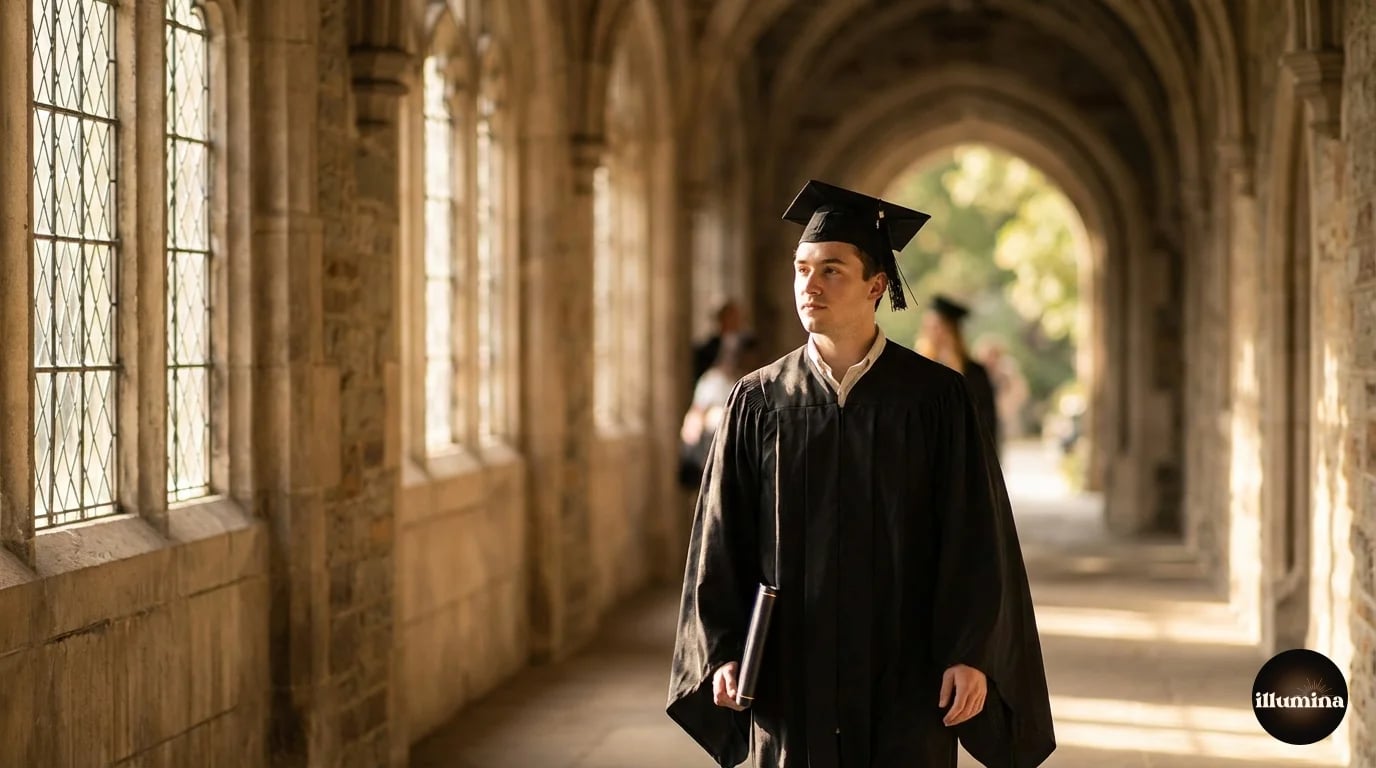
On Campus
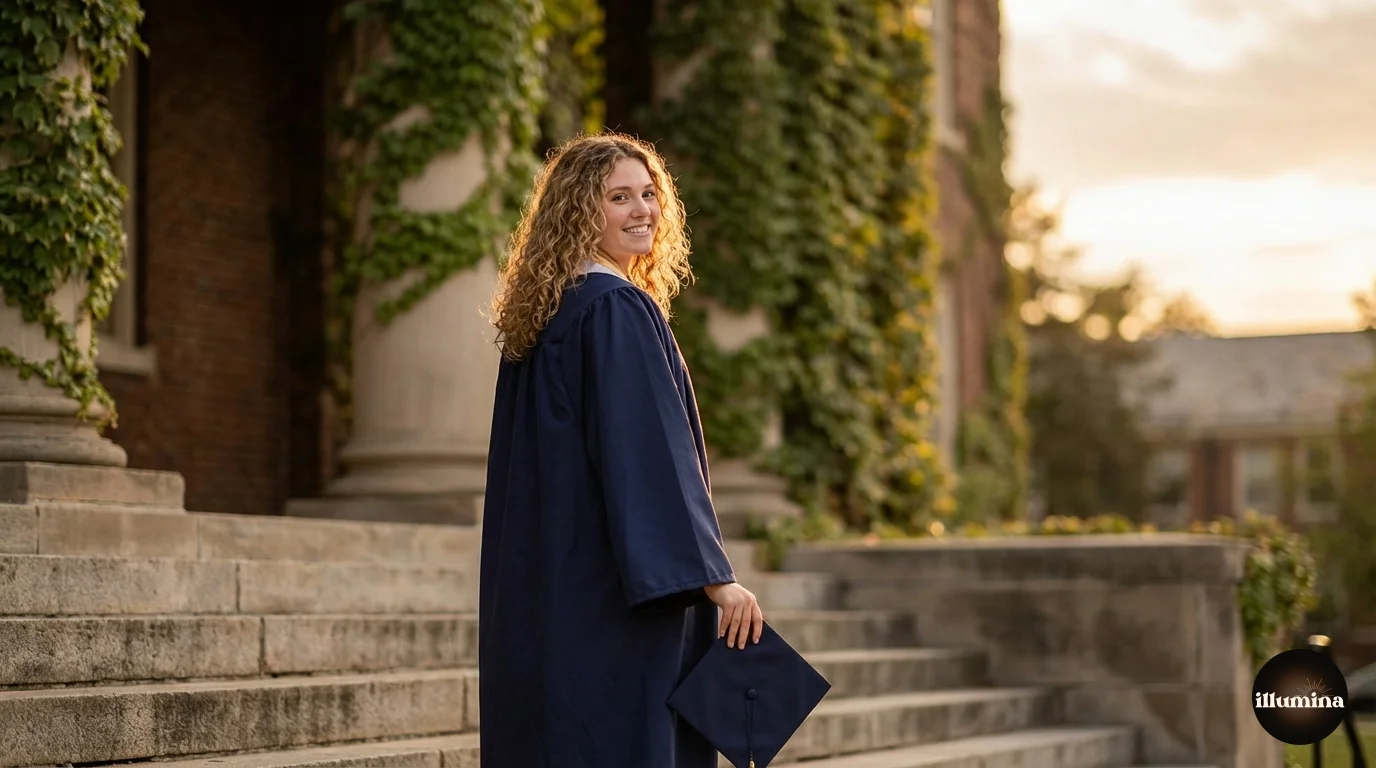
The obvious choice, and usually the right one. Campus buildings have architecture that photographs beautifully: columns, arched doorways, brick walls, ivy, staircases, libraries with tall windows. Walk the campus the week before and look for spots with interesting backgrounds that aren't too busy. A long hallway with natural light from one side. The steps of the main building. A courtyard with mature trees.
Avoid the most popular photo spots if you can. Every graduate and their family will be fighting for the same three locations. Scout for the beautiful corner of campus that nobody thinks to use. The old science building with the arched windows. The bridge over the campus pond. The reading garden behind the library. Less competition, more variety, and your photos won't look like everyone else's.
Downtown or Urban
If the graduate is heading to a city after school, urban shots make a nice narrative. Brick walls with texture, mural backdrops, coffee shop fronts, crosswalks with leading lines. The gown contrasts well against urban settings because it's formal against casual. Keep it to one or two urban shots mixed into a campus-heavy set. A full session in a parking garage feels disconnected from the achievement.
Nature and Parks
Fields, gardens, tree-lined paths. These work especially well for pre-K and elementary graduations where the setting is less about the institution and more about the kid. Find open shade or shoot at golden hour. Wildflower fields are gorgeous but check for allergies and bugs first. Nothing kills a session faster than a sneezing fit or a bee sting in the middle of a pose.
At Home
Don't overlook the backyard. A simple setup against a fence with climbing roses, a front porch with good light, or even the front door of the house they grew up in. These photos age beautifully because they capture where the graduate was, not just what they wore. Twenty years later, the front porch photo hits harder than the one in front of the campus fountain.
Pose Ideas by Age Group
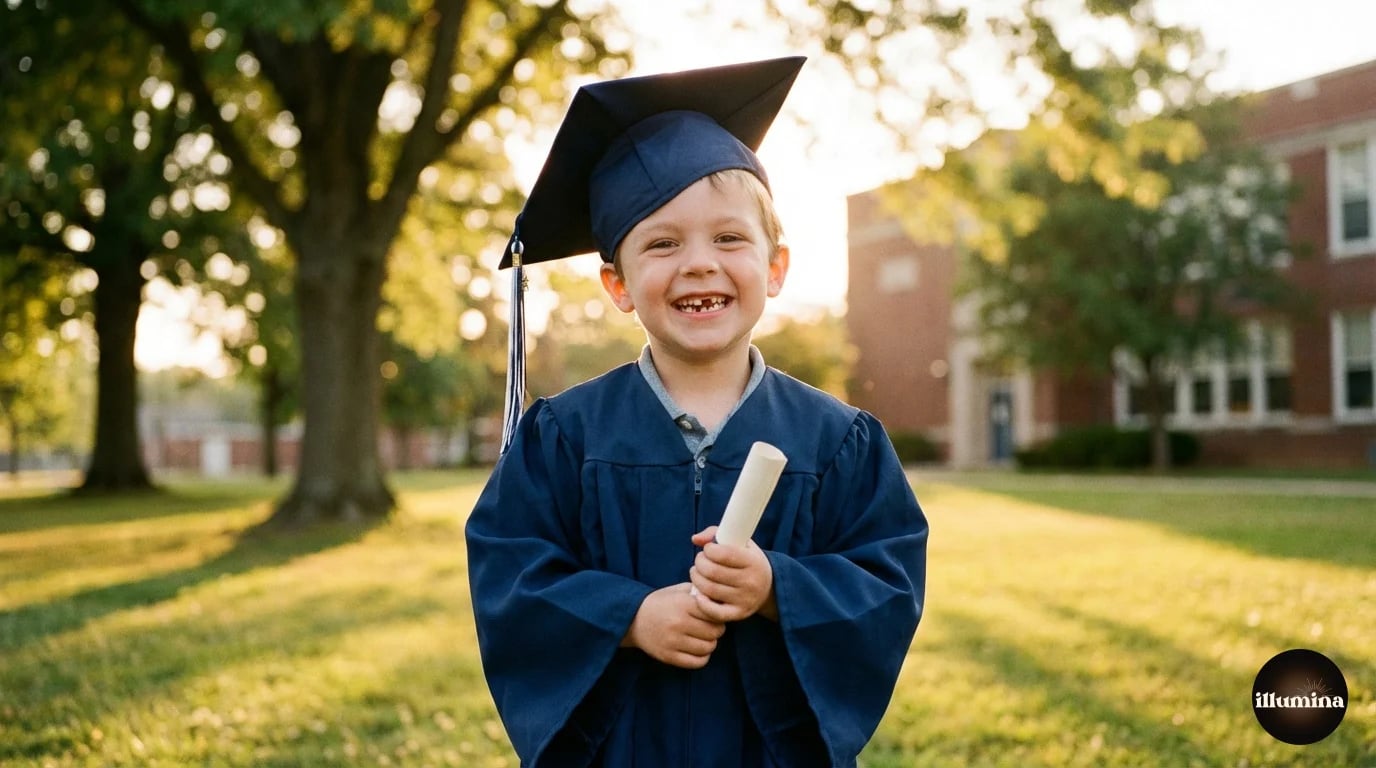
Pre-K and Kindergarten
Keep it simple and fast. These kids have about a five-minute window of cooperation, and that's being generous. The cap will fall off constantly. Embrace it. The best pre-K graduation photos are candid: adjusting the cap, looking up at a parent, holding a tiny diploma with both hands, walking away from the camera with the gown dragging on the ground. Don't try to get them to stand still and smile at the lens. Get down to their eye level and let them move.
Elementary and Middle School
Kids this age can follow directions but get self-conscious fast. Give them something to do. Toss the cap (you'll need ten tries to catch the timing). Walk along a path and look back over their shoulder. Sit on the steps and lean forward with their chin on their hands. Read their diploma like they're studying it. The interaction with the prop keeps them from freezing up into the dreaded "school photo smile."
The cap will fall off constantly. Embrace it. Some of the best pre-K graduation photos are the kid reaching up to fix a cap that's three sizes too big. Don't fight it, just keep shooting.
High School Seniors
This is where you can get creative. Seniors are old enough to take direction and young enough to still have fun with it.
The classic: standing tall, gown closed, cap straight, diploma in one hand at their side, looking directly at camera with a confident smile. Get this one first so it's done. Then move on to the interesting stuff.
Looking back over the shoulder while walking away from camera. This is one of those poses that works every single time. The graduate walks slowly, you call their name, they look back, you shoot. Natural, confident, and it tells a story.
Sitting on steps with the cap in their lap, looking off to the side. Casual, relaxed. Works well as a horizontal crop.
Cap toss. The solo version. They throw the cap and you shoot at the peak. You'll need burst mode and you'll need five or six tries. Worth it for the one frame where the cap is perfectly framed against the sky and their arms are up.
Leaning against a wall or column, gown open, casual outfit showing underneath. This reads as "I'm done and I'm ready for what's next." Works especially well for seniors heading to college.
College and Graduate School
More formal, more polished. College graduates tend to want photos that look professional rather than playful. A three-quarter pose in front of a campus landmark, gown closed and pressed, stole or honor cords visible. Eye contact with the camera, slight turn of the shoulders so the frame isn't flat.
For doctoral graduates, the velvet tam and hood are the stars. Make sure they're visible. A profile shot showing the hood colors draped down the back is a must. These regalia details matter and they're hard to photograph well if you're not paying attention to how they fall.
Group and Family Shots
Every graduation session should include at least two or three group photos. They're the ones that end up framed.
Graduate with parents. Put the graduate in the center, parents on each side, slightly behind. Everyone angled inward toward the graduate. This creates a V-shape that draws the eye to the grad. If there's a height difference, put the shorter person on a step or curb.
Graduate with siblings. Let it be a little looser. Arms around each other, genuine laughs. If the siblings are much younger, the graduate can pick them up or crouch down. The height contrast between a six-year-old and a cap-and-gown senior is inherently charming.
Friend groups. These are chaos and that's the point. Line up, everyone throws caps, one person is always blinking. Take fifteen frames and pray. The slightly messy group shot where everyone is laughing at something that went wrong is always the one that gets posted.
Extended family. Get this one done fast before anyone wanders off. Put the graduate front and center, tallest people in back, kids in front. Count to three, take five frames, move on. Nobody enjoys standing in a big group photo. The faster it's done, the more natural the expressions.
For the extended family shot, count to three and take five frames fast. Nobody enjoys standing in a big group. The faster it's done, the more natural the expressions. You'll pick the one frame where nobody is blinking.
Transform Your Photos
Give Your Photos the Wow Factor
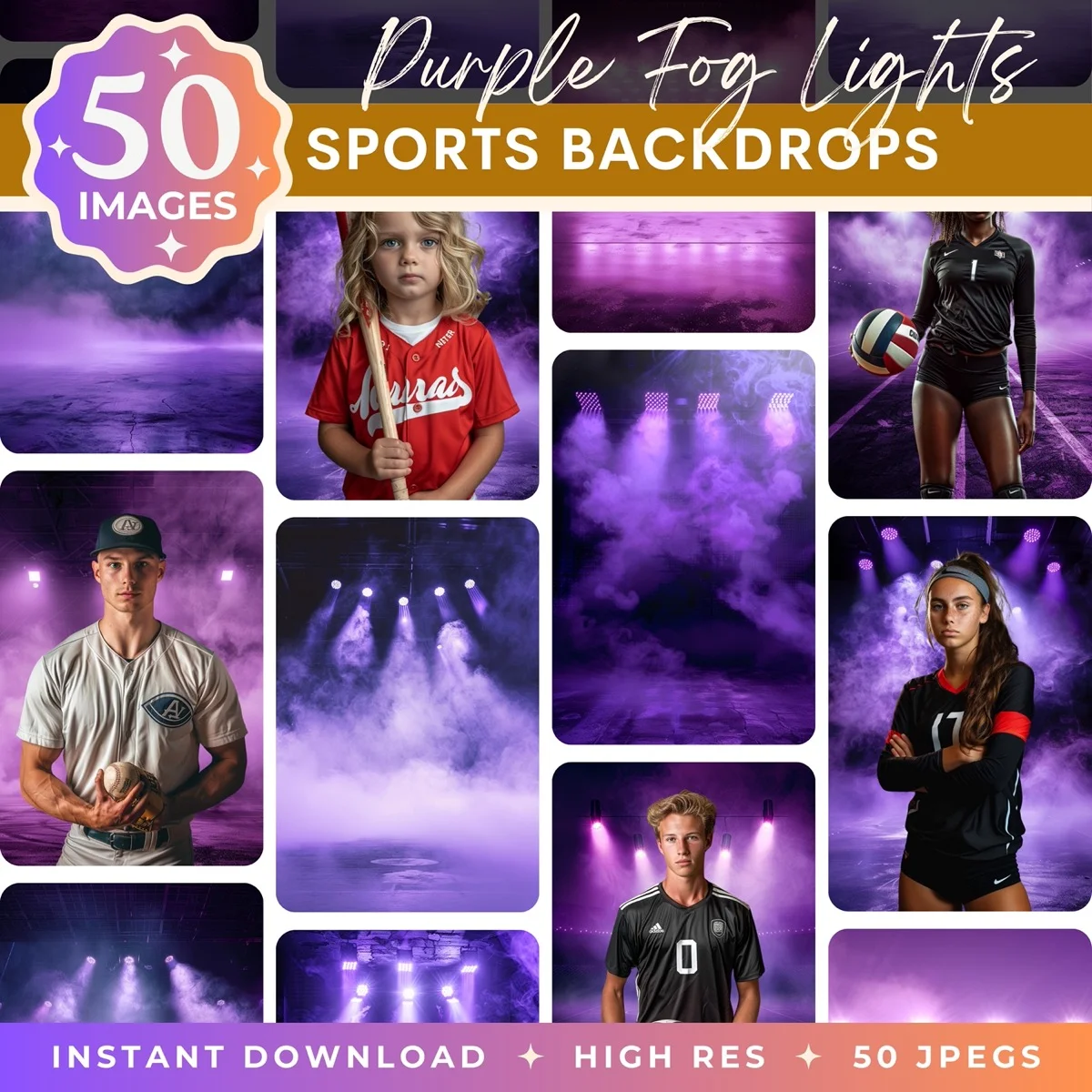
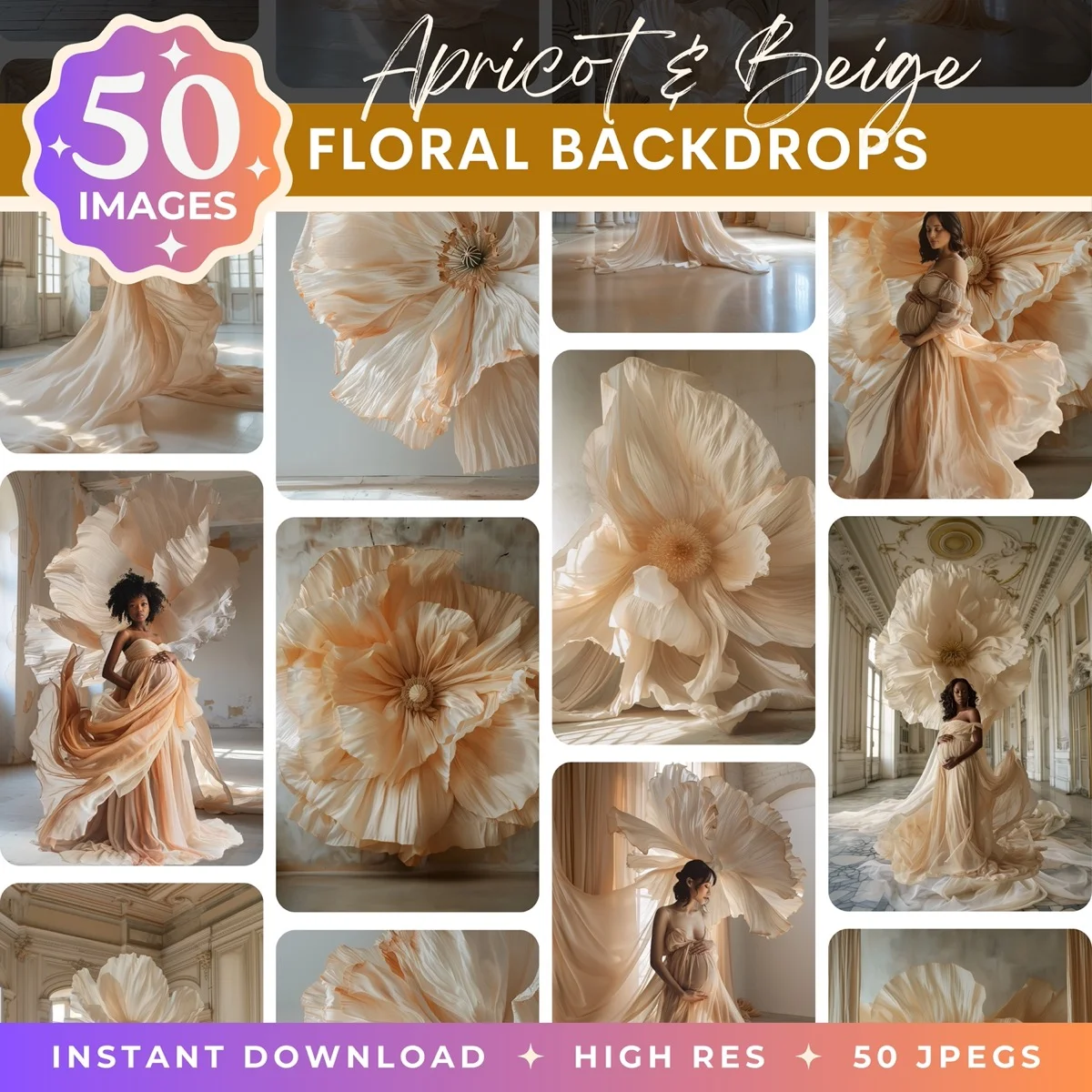
Browse our collection of premium digital photo backdrops. 50 high-resolution print-ready backgrounds in each pack. Instant download.
Browse Backdrops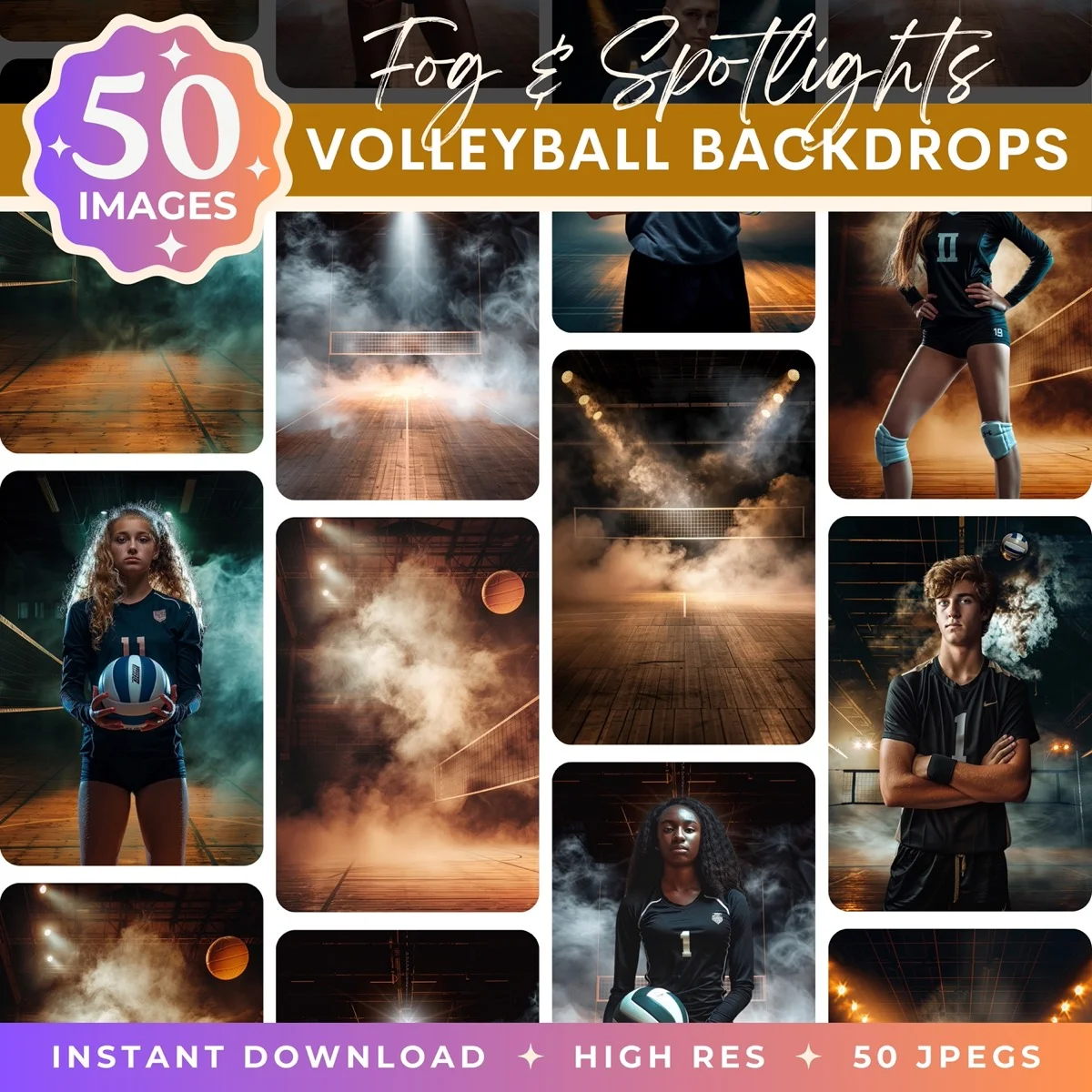

What to Wear Under the Gown
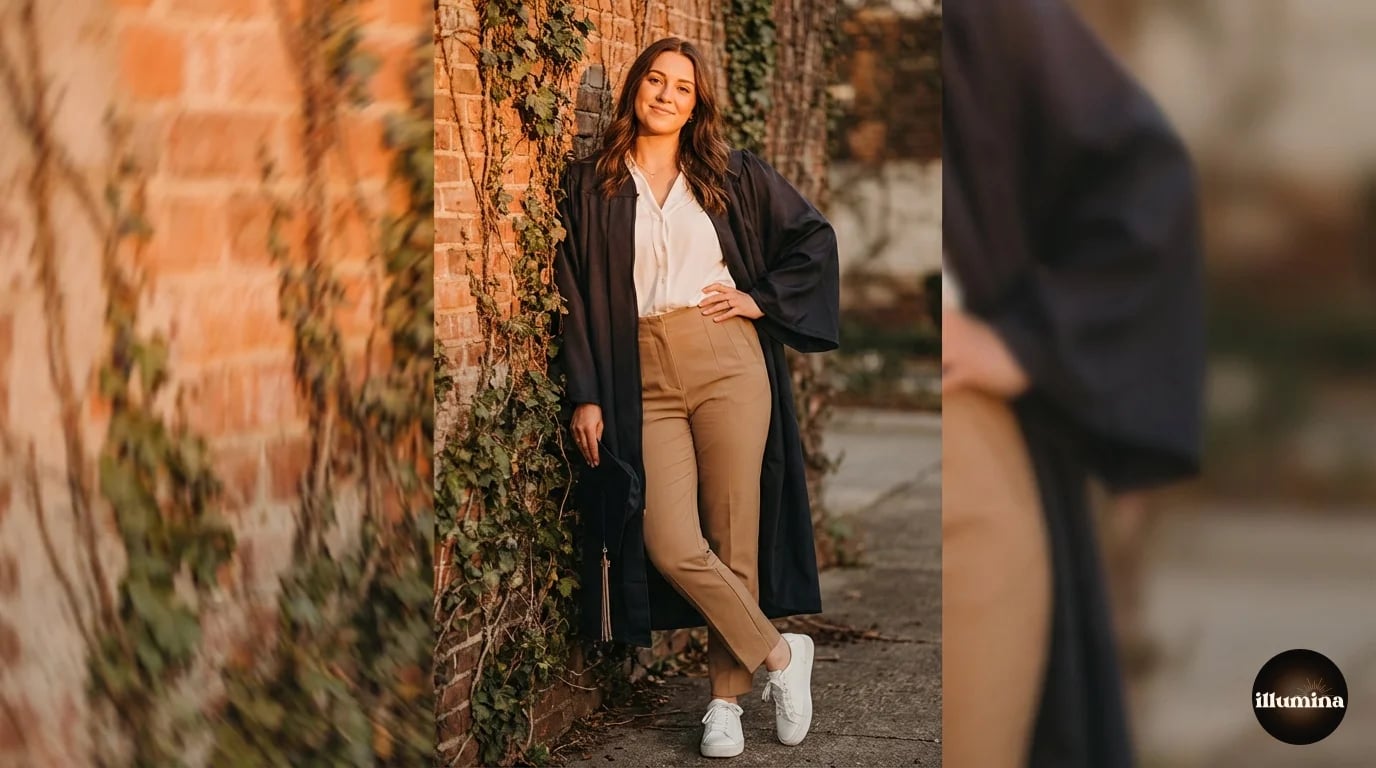
The gown covers most of your outfit, but the neckline shows, and for the "gown open" casual shots, the whole outfit matters.
For women: a dress or blouse with a clean neckline works best. V-neck or crew neck. Avoid busy patterns that fight with the gown. Solid colors in white, black, or a muted tone look polished. Heels if you want them, but you'll be walking on grass and gravel, so wedges or block heels are smarter than stilettos.
For men: a button-down shirt with the top button open, or a suit without the jacket. A tie is optional but adds a nice formal touch for the "gown open" shots. Dark pants, clean shoes. Sneakers with a gown look intentional if they're clean and the rest of the outfit is put together. Dirty sneakers just look like you forgot.
Skip the graphics tees, logos, and anything too casual unless that's the look you're going for. The gown-open shot is supposed to reveal the person underneath the ceremony. Make it count.
Compositing with Digital Backdrops
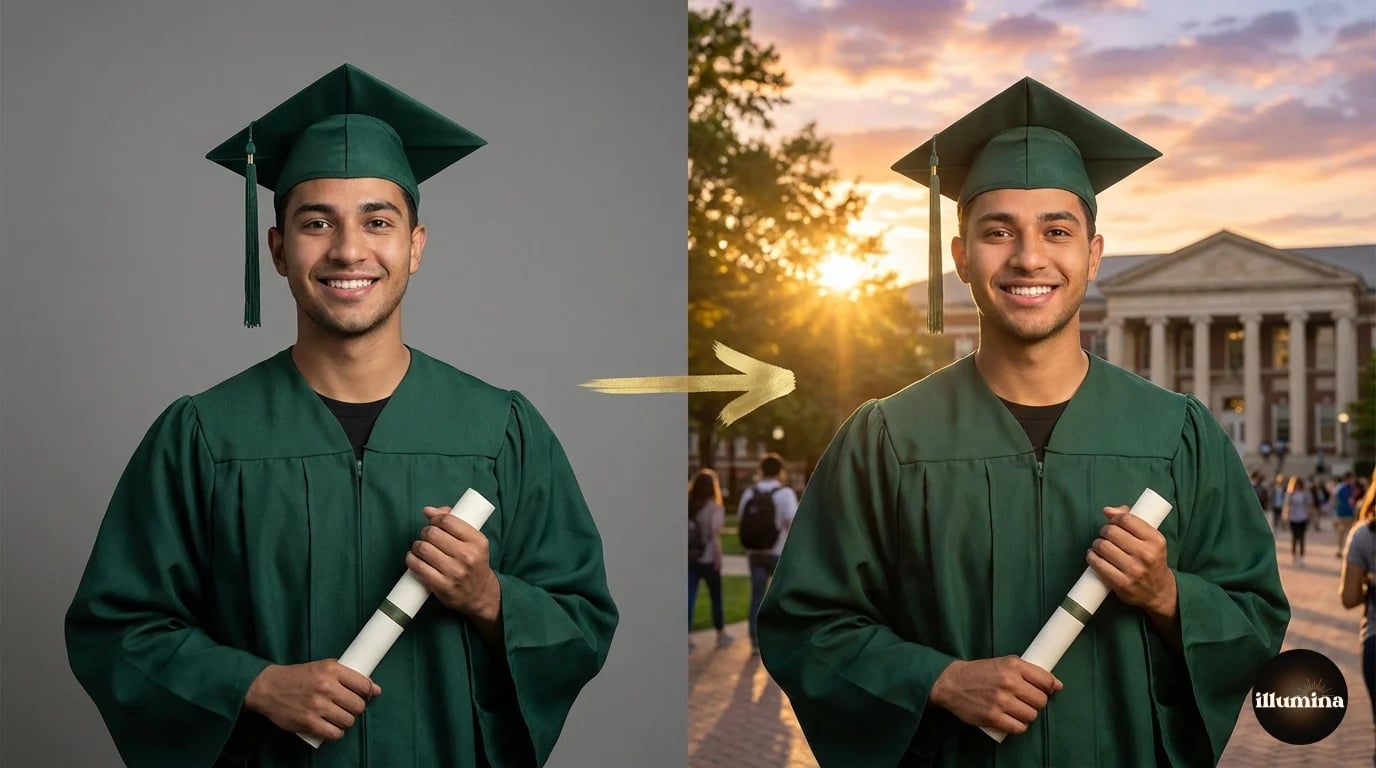
Not every graduation session happens at a photogenic campus. Community colleges, trade schools, and online programs don't always have the ivy-covered buildings and grand staircases that make for easy backdrops. And sometimes the weather just doesn't cooperate.
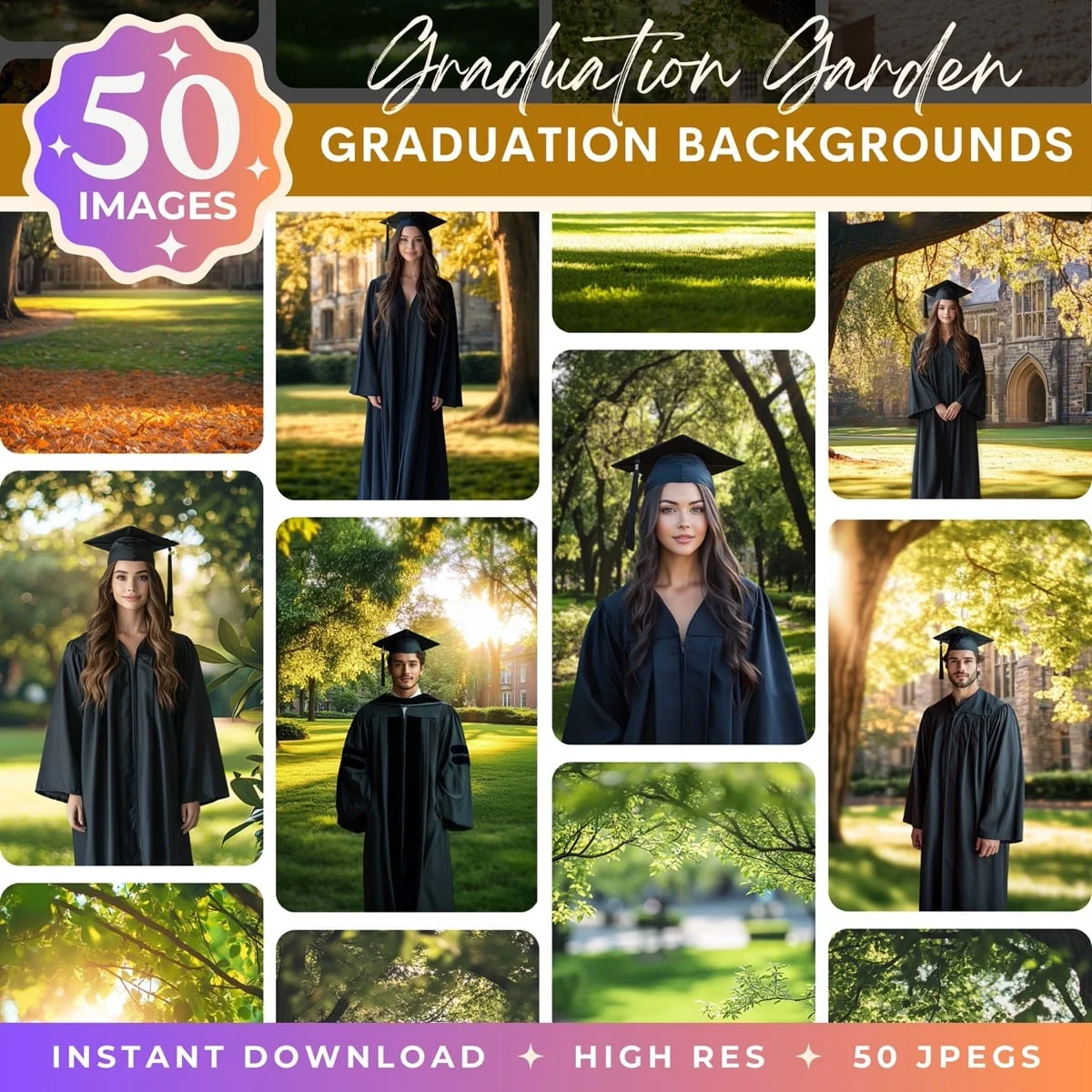
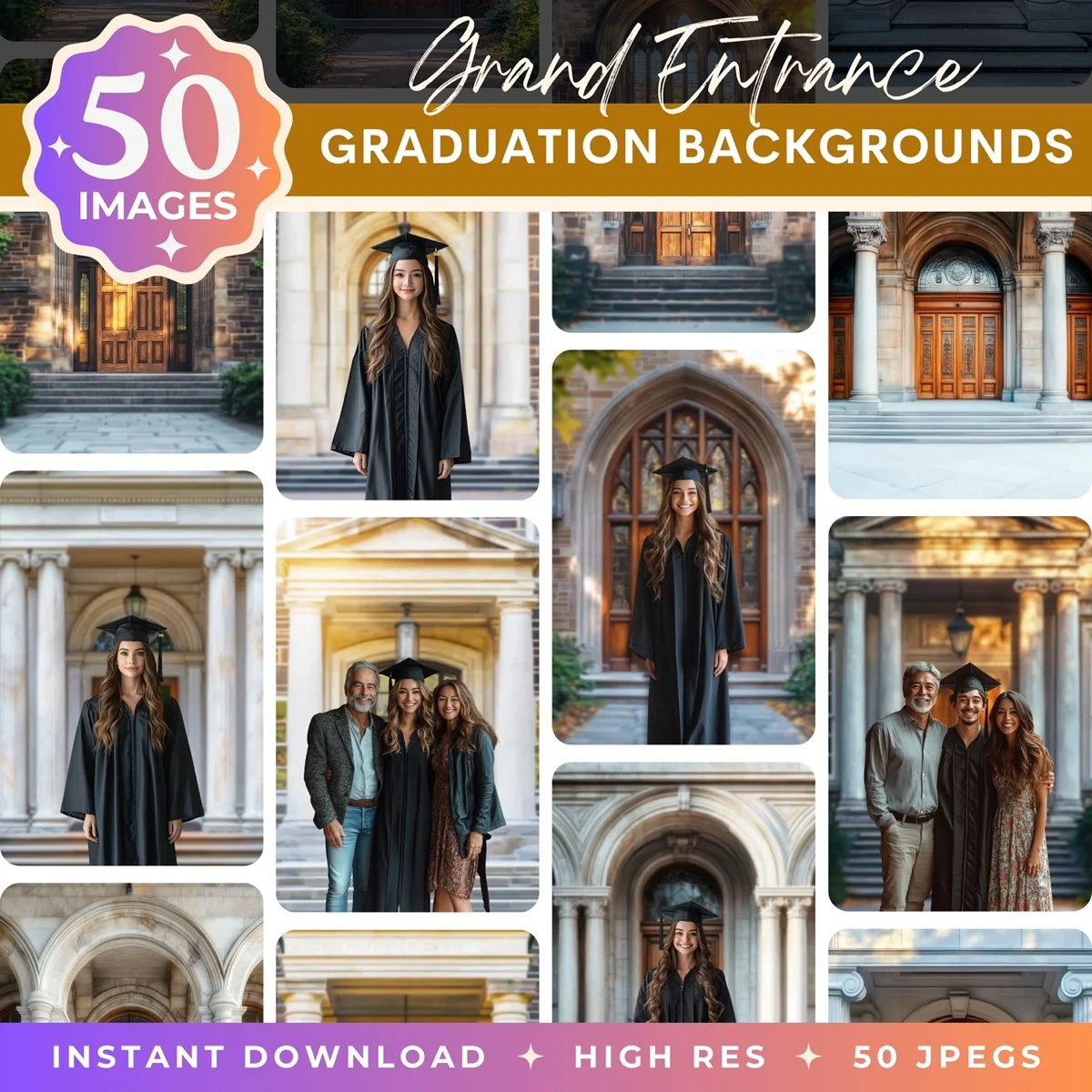
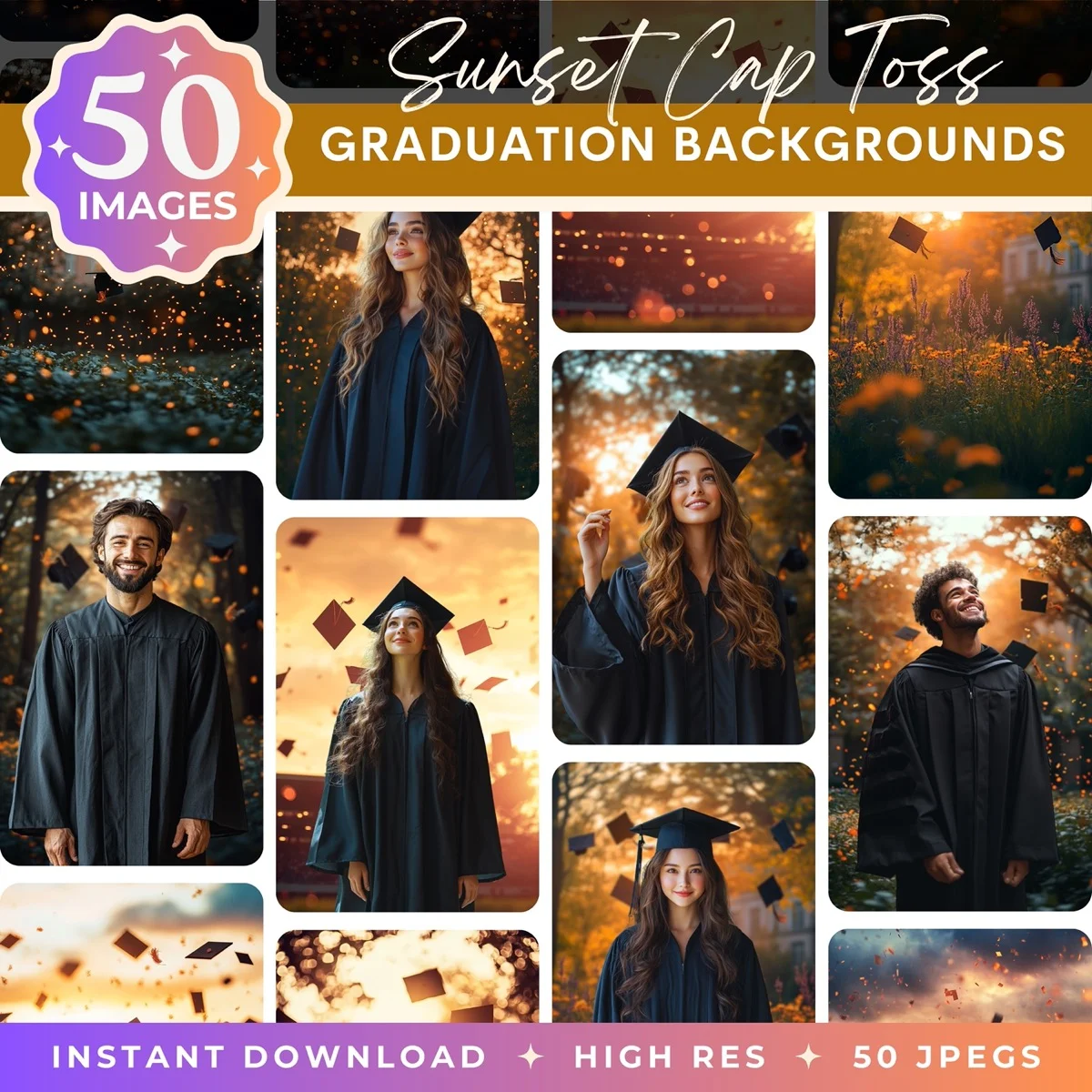
That's where digital backdrops come in. Shoot the graduate in a studio or even a living room against a clean background, then composite them onto a professional scene. A rose garden, a columned entrance, a sunset field, a grand staircase. The result looks like you traveled to the location without leaving the room.
The workflow is straightforward. Photograph the graduate against a plain backdrop (gray, white, or any solid color). Remove the background in Photoshop or Canva. Place the cutout onto the new backdrop scene. Adjust color temperature and add a shadow. Export. We cover this step by step in our guide on how to create composite photos in Canva and in more detail in our Photoshop background removal guide.
For photographers who shoot a lot of graduations, compositing cuts session time in half. You can offer ten different "location" looks from a single 20-minute studio shoot, which means more variety for the client and more revenue per session for you.
Lighting Tips
The graduation cap brim is a shadow machine. In overhead sun, it throws a dark shadow across the entire upper face, hiding the eyes and making the graduate look like they're wearing a visor in a noir film. Three ways around it.
Tilt the cap back slightly. Just a centimeter or two. It lifts the brim enough to let light reach the eyes without looking crooked. Most graduates do this naturally because the cap doesn't fit well anyway.
Use open shade. Position the graduate under a tree canopy or on the shaded side of a building. The light becomes diffused and directional rather than overhead, which means no harsh brim shadow. The background stays bright and the subject gets soft, even light.
Use a reflector or a phone. If you're in direct sun and can't move, have someone hold a white reflector (or even a white poster board) below waist height angled up toward the face. It bounces light up under the cap brim and fills in the shadow. In a pinch, a phone screen on max brightness held at waist level does a similar thing for close-up portraits.
Check the tassel side in every single frame. It should be on the right before the ceremony, moved to the left after. A backwards tassel in a framed photo is the kind of thing that bothers people for years.
Props and Details Worth Capturing
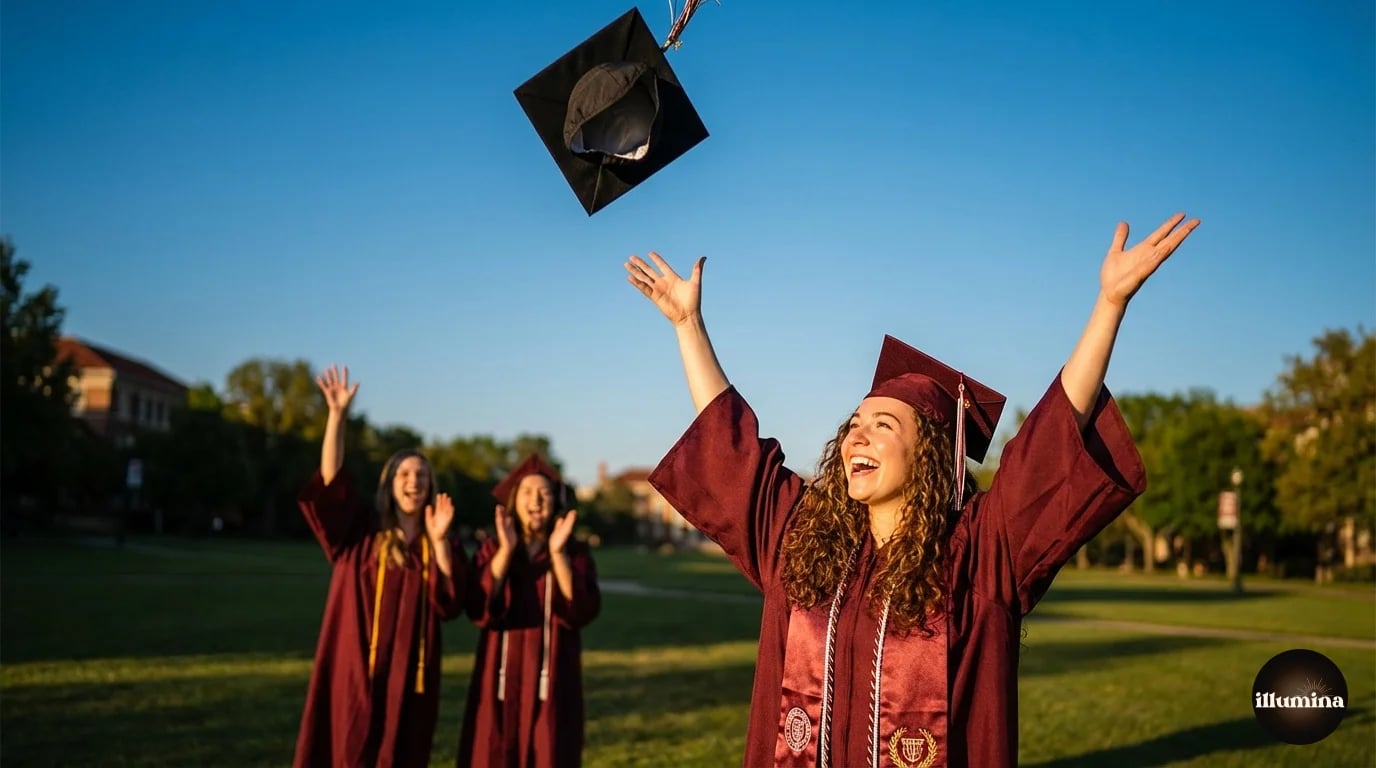
The cap and gown get all the attention, but the smaller details are what make a graduation gallery feel complete. Shoot the details early in the session while everything is still clean and pressed.
The tassel close-up. Have the graduate hold the cap at their side, tassel hanging. Shoot it at a shallow depth of field so the tassel is sharp and the background melts away. This works as a standalone image and also pairs well next to a full-body portrait in a gallery or album.
The diploma or degree. Unrolled, held at reading height, or tucked under an arm. Don't fake it with a blank paper roll if the real one hasn't arrived yet. Just skip it. People can tell.
Honor cords, stoles, and pins. If the graduate earned them, photograph them. A close-up of an honor society stole draped over the gown is the kind of detail that gets printed and framed on its own. For cultural stoles (kente, lei, sash), spend extra time getting these right. They carry weight beyond the ceremony.
The invitation and the year. If the family ordered printed announcements, lay one flat and shoot it alongside the cap or diploma. This grounds the photos in a specific time. Twenty years later, it provides context that a portrait alone can't.
Shoes. It sounds odd, but shoes in graduation photos have become a thing. The graduate's choice of footwear says something about who they are. Jordans under the gown, cowboy boots, heels they can barely walk in, the beat-up Converse they wore every day for four years. Shoot the shoes against the hem of the gown and let the story tell itself.
Common Mistakes
Shooting in the middle of the day. The light is terrible and everyone is squinting. If the ceremony is at noon, take the formal photos the evening before or the morning after.
Forgetting to check the cap and tassel. The tassel should be on the correct side for the graduate's level (typically right before the ceremony, moved to left after). Check it in every frame. A backwards tassel in a framed photo is the kind of thing that bothers people for years.
Only shooting posed. Get the candids too. Walking to the ceremony, adjusting the cap in a car mirror, hugging a friend, the moment right after they realize it's over. These are the photos that have emotional weight.
Ignoring the background. A gorgeous pose means nothing if there's a trash can or a porta-potty in the background. Check the edges of your frame before you shoot. Take two steps left or right to clean up the background. A small move from the photographer makes a huge difference in the final image.
Not taking enough variety. Five variations of the same pose against the same wall isn't a session, it's a passport photo with different angles. Move locations every 10-15 minutes. Mix posed and candid. Get close-ups of the cap, the diploma, the shoes, the details. A 30-image gallery with variety tells a story. A 30-image gallery of the same shot does not.
Professional graduation scenes for portrait compositing
Graduation photos don't need to be complicated. Good light, a meaningful location, a few genuine moments, and enough variety to tell the story. That's it. The cap and gown do most of the work. Your job is to not get in the way of the moment.
Transform Your Photos
Give Your Photos the Wow Factor
Browse our collection of premium digital photo backdrops. 50 high-resolution print-ready backgrounds in each pack. Instant download.
Browse Backdrops